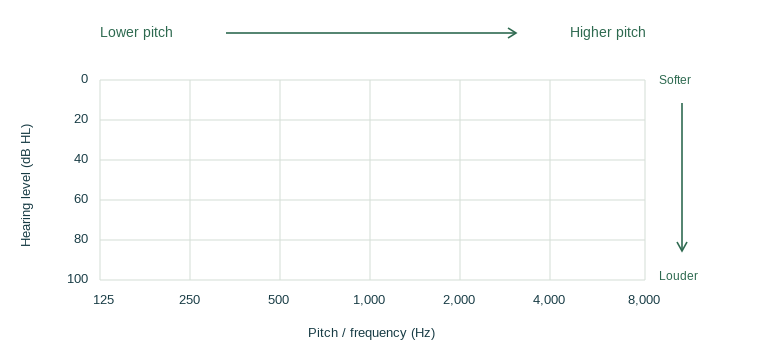
An audiogram records the quietest tones you respond to at different pitches. It is one part of a hearing assessment and does not, on its own, describe every aspect of speech understanding or decide which hearing aid you need.
Start with the two directions on the graph
Pitch, or frequency, runs across the chart and is measured in hertz (Hz). Lower-pitched tones sit towards the left and higher-pitched tones towards the right. Hearing level runs vertically in decibels hearing level (dB HL). Marks further down the usual chart mean a louder test tone was needed before you responded.
Ask the clinician to point out the results for each ear and explain the symbols used. Colours and symbols can help distinguish ears and test methods, but the key on your own chart matters. Do not compare two charts just by the appearance of a line.
What the graph cannot tell you by itself
A tone test measures a particular response under the test conditions. Your experience of a conversation also depends on the situation: distance, competing voices, how clearly someone speaks and the support you use.
The clinician interprets the measurements alongside your history and other findings. Avoid turning a chart into a diagnosis yourself, or assuming that a single number tells you everything about your hearing.
Five questions to ask before you leave
- What does the result show for each ear?
- How does that fit with the difficulties I described?
- Were the results reliable, and is any further assessment needed?
- What are my options, including choosing to monitor things?
- Can I have a copy and an explanation of the next steps?
If an explanation feels too technical, ask for it again in everyday language. You do not need to remember every term to make an informed decision.
If you already have an audiogram
Bring the complete chart, its date and any accompanying notes to your appointment. Say where it was carried out and whether you noticed a change afterwards. This gives the professional a clearer starting point than a photograph of a small part of the result.
Ask whether comparison with previous results is appropriate. Different test methods or conditions can affect what a comparison means; a professional should interpret any apparent change.
An online check is a different starting point
An online hearing check may help you decide to seek advice, but it is not the same as a full clinical hearing assessment. Headphones, volume settings and background sounds can affect a home check. A reassuring online result should not override persistent concerns or urgent symptoms.
You can read RNID guidance on getting your hearing tested or Soundwell's hearing-test guide to understand the next step.